
Diving into History: Cleopatra’s Palace Underwater in Alexandria, Egypt
The Legend of the Sunken Cleopatra City
Alexandria was once the Mediterranean’s brightest intellectual and political center. Its royal quarter—often called Cleopatra City—now rests beneath the waves as one of the most significant underwater archaeological sites in the Mediterranean. Archaeological and geological evidence indicate the shoreline changed dramatically more than 1,400 years ago after seismic events, leaving ceremonial buildings and harbors submerged.
Scholars term Antirhodos the island at the heart of the royal complex — the island-based core of Ptolemaic power: a network of ceremonial halls, temples, and harbor works forming the palace precinct. Ancient writers describe a grand portus magnus and monumental quays; archaeologists now find those descriptions matched by stone and pavement on the seabed.
Modern understanding rests on publications and fieldwork by the IEASM under Franck Goddio. From the late 1990s onward, the Goddio team mapped the Eastern Harbor, recovering pavements, statues, and architectural remains in situ and publishing detailed reports linking these finds to the Ptolemaic rulers and their ceremonial landscape.
What Lies Beneath Underwater Alexandria
Descending into underwater Alexandria feels less like a recreational dive and more like entering a drowned museum: suspended fragments of a royal city lie on the seabed, preserved under silty blankets that have protected stone and decoration for centuries.
Key Discoveries at Cleopatra’s Palace
- Royal Pavements: Broad marble and mosaic floors remain largely in situ — walkways once trod by Ptolemaic courtiers now visible beneath a thin film of silt, with tesserae remarkably intact.
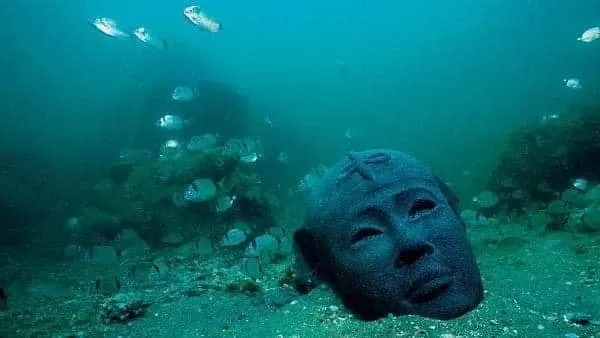
- Colossal Statues: Granite and red-granite figures — sphinxes, divine images of Isis, and regal portraits — rest where they toppled, anchors of the submerged urban landscape.
- The Bust of Caesarion: A head attributed to Cleopatra’s son with Julius Caesar, giving the site a human scale and linking the remains to historical rulers.
- Red Granite Columns: Massive column drums and capitals, some quarried from distant granite sources, mark the outlines of former halls and temples, with traces of ancient tooling and iconography.
Field reports document additional finds: quartzite blocks with engraved royal cartouches, pharaonic motifs, and temple fittings confirming the area’s sacred and administrative functions. Some engraved blocks and carved reliefs have been raised to shore for conservation; heavier objects largely remain on the seabed.
Together, these objects and architectural remains reveal the fusion of Greek and Egyptian traditions at the palace precinct.
Important Things to Know Before Diving
This is not recreational reef diving. Treat visits as guided archaeological exploration: operators follow strict conservation protocols, and dives are planned around research and preservation needs.
- Book licensed centers: All dives to the Eastern Harbor operate under permits issued by Egyptian authorities and may coordinate with ongoing research missions.
- Expect low visibility: Sediment, harbor traffic, and seasonal currents commonly reduce sightlines; plan brief, focused bottom times.
- Do not touch objects: Heavy stone remains stay on the seabed to avoid damage.
- Photography & permissions: Some operators allow photography; others require prior authorization from authorities or museum partners.
- Fitness & certification: Depths are modest, but certification is required. Bring dive insurance and review emergency plans.
Ask before booking: Which permits are held? Are conservation rules followed?
Diving in Alexandria: An Adventurer’s Guide
For certified divers, Alexandria offers an uncommon blend of archaeology and adventure: shallow, historically rich dives in the Eastern Harbor.
What to Expect
- Location: Eastern Harbor — the ancient portus magnus that serviced the royal palace.
- Depth: Typically 5–10 meters — accessible but requiring controlled buoyancy.
- Visibility: Typically 2–8 meters, improving in calm conditions.
- Experience: Archaeological survey dives — hover over pavements, observe colossal statues, and note carved blocks, rather than coral reefs.
Pro‑Diver Checklist
- Certification: Open Water minimum; Advanced recommended.
- Equipment: DSMB, torch, compass, surface marker. Gloves for warmth only.
- Boat: Short rides from Alexandria’s modern harbor, 15–30 minutes.
- Bottom time: 20–30 minutes, conservative gas margin.
- Best months: Spring (April–May) and autumn (September–October).
- Booking: Through licensed centers with permits; confirm dive coincides with research activity.
Why Most Tourists Never Hear About Cleopatra’s Sunken City
Access is deliberately limited to protect fragile mosaics, statues, and carved blocks. Licenced, small-group visits reduce wear and provide an intimate encounter with sunken monuments — a rare chance to see centuries of history lying on the seabed.
Can’t Dive? How to See Cleopatra’s Legacy Above Water
Museums and open-air displays present raised objects, contextual interpretation, and conservation work, bringing the island precinct of Antirhodos to life.
Where to Go
- Alexandria National Museum: Exhibits include carved quartzite blocks, inscribed stones, and sculpted heads recovered from the Eastern Harbor.
- Kom El Shoqafa Open Air Museum: Outdoor setting with colossal statues and column fragments, including signage explaining provenance and conservation treatment.
Suggested Short Itinerary: Morning at Alexandria National Museum, afternoon stroll along the modern harborfront to imagine the ancient portus magnus and glimpse sites where sunken temples and palace precincts once stood.
FAQ
Can any tourist go diving in Alexandria?
Yes, via licensed centers running guided archaeological dives and “Discovery” experiences; all are supervised and limited in group size.
Is it safe?
Yes, with an experienced operator. Sites are shallow, but visibility and harbor traffic create added risk. Ensure guides, surface support, and insurance.
What is the depth and visibility?
Shallow dives, 5–10 meters. Visibility varies from 2 to 8 meters depending on season, tides, and harbor conditions.
Do I need a permit?
Yes, generally handled by licensed operators. Independent diving without authorization is prohibited.
How do I get insurance?
Purchase dive insurance covering archaeological dives and emergency evacuation.
How long have these sites been studied?
Systematic surveys by IEASM and Franck Goddio began in the late 1990s and continue with ongoing research.
The Verdict: Is It Worth It?
For travelers who prize archaeology, narrative-rich encounters, and offbeat adventures, underwater Alexandria is unquestionably rewarding. Whether descending to hover above submerged columns and temple remains or visiting museums to see conserved objects, Cleopatra’s palace precinct delivers a rare, tactile encounter with a vanished royal world.
Discover Alexandria’s Underwater Wonders with Ramasside Tours.
Experience diving Alexandria Egypt with Ramasside Tours and explore Cleopatra’s Palace and the Lighthouse with certified instructors and full equipment.